| Botanical name | Sorbus aucuparia |
|---|---|
| Family | Rosaceae |
| Hardy rating | RHS H7 (extremely hardy) |
| Fruiting season | August–October |
| Height (mature tree) | 5–15 m |
| Position | Full sun to partial shade |
| Habitat | Woodland, moorland, mountain, roadsides, gardens |
| Edible raw? | Not recommended — mildly toxic raw; safe when cooked |
The rowan tree — also called mountain ash, though it's not related to the ash family — is one of the most beautiful native trees in Britain, particularly in autumn when the clusters of bright orange-red berries glow against the yellowing leaves. It's found across the whole country, from suburban streets to exposed mountain slopes above 800 m, and it's been woven into British and Celtic folklore for centuries: planted near doorways to ward off evil, carried as a protective charm, and regarded in parts of Scotland and Wales with a reverence that made cutting one down a serious taboo.
The berries are edible, but with an important caveat: raw rowan berries contain parasorbic acid, which causes digestive upset and, in larger quantities, can be more seriously harmful. Cooking destroys this compound entirely, making the berries safe and producing a sharp, bitter-sweet flavour that works brilliantly in jelly, syrup, and wine. Rowan jelly is one of the classic British wild fruit preserves — intensely flavoured, with a beautiful amber-orange colour and a pleasant bitterness that cuts through rich meat.
Identifying Rowan
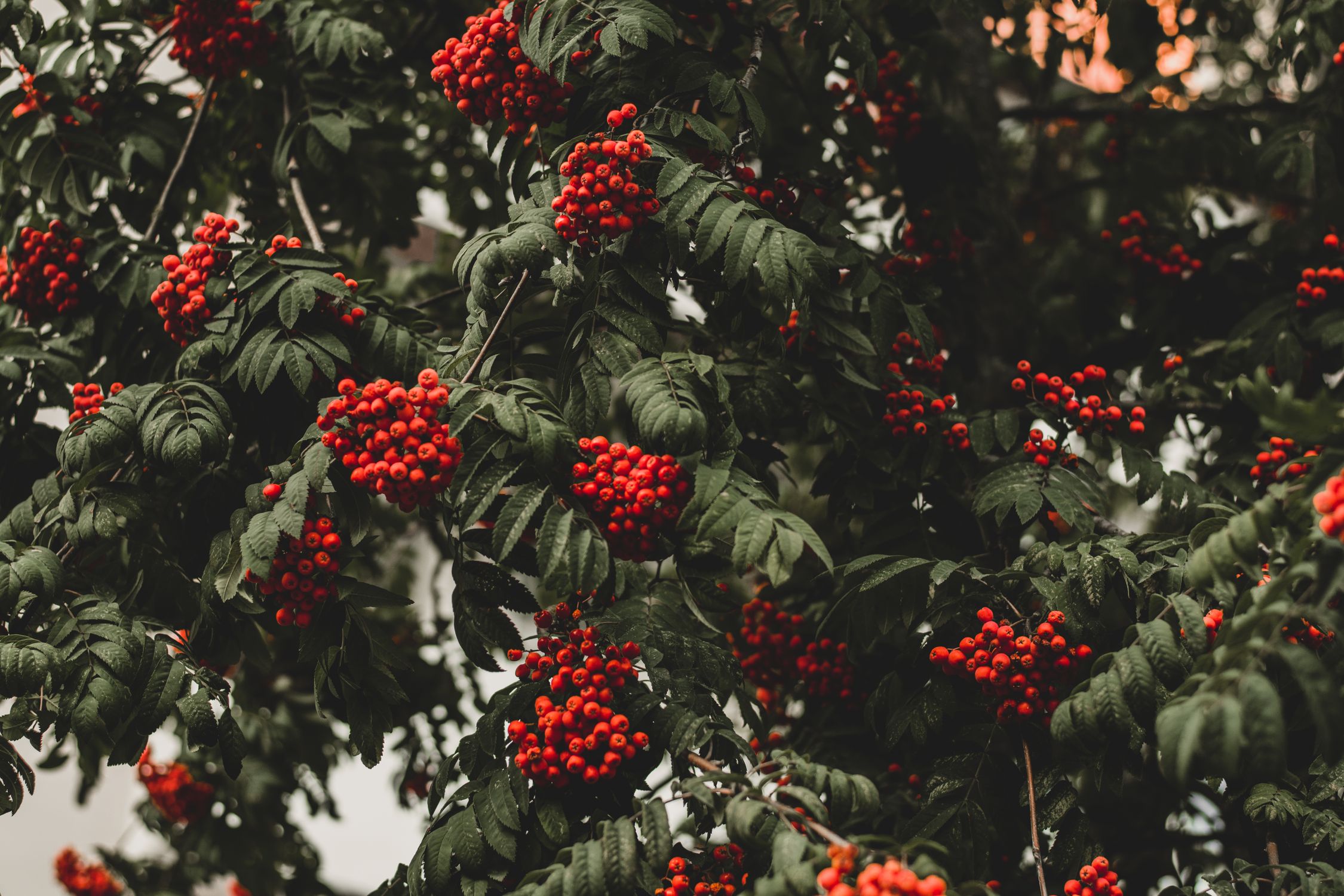
Rowan (Sorbus aucuparia) is unmistakable at most times of year. The leaves are pinnate — like an ash tree, with multiple pairs of small, oval, toothed leaflets arranged along a central stalk, typically 5–8 pairs plus a terminal leaflet. In autumn they turn yellow, orange, and red before falling. The bark on young trees is smooth and silvery-grey; on older trunks it becomes rougher.
In May and June, flat-topped clusters of small creamy-white flowers appear — similar in structure to elder flowers but with a more distinctive, somewhat unpleasant smell up close. By August the flower clusters have become dense, drooping bunches of bright orange to red berries, each berry about 8–10 mm across, round, with a tiny brown remnant of the calyx at the tip.
The berries are very distinctive in combination with the pinnate leaves — there's nothing else in Britain with both features. The most superficially similar trees are elder (flat berry clusters, but elder berries are dark purple-black, not red, and the berries hang rather than sit in flat-topped clusters) and hawthorn (also red berries in autumn, but hawthorn has simple deeply-lobed leaves, not pinnate, and the berries are oval not round). Once you've seen rowan, you won't confuse it.
There are several cultivated Sorbus species and hybrid rowans planted in parks and gardens — most produce similar orange or red berries that are also usable in the same way as wild rowan.
The Raw Toxicity Issue
This is worth understanding clearly. Raw rowan berries contain parasorbic acid (also called sorbic acid lactone), a compound that can cause vomiting, diarrhoea, and stomach cramps if eaten in any quantity. Children are particularly at risk as the bright red berries are visually attractive. You'd need to eat a significant number of raw berries to cause serious harm, but eating a handful raw is genuinely inadvisable.
Cooking completely destroys parasorbic acid — it converts to sorbic acid, which is harmless and is actually a widely used food preservative. Any jelly, syrup, wine, or other product made from cooked rowan berries is entirely safe. This is the crucial point: the cooking-safe / raw-unsafe distinction makes rowan berries different from most other British hedgerow fruits, but it doesn't make them dangerous for a knowledgeable forager who processes them correctly.
After a hard frost, the parasorbic acid level also reduces naturally — traditional foraging advice often recommends waiting until after the first frost for this reason. This is useful guidance, though processing by cooking is reliable regardless of frost timing.
When and Where to Forage
Rowan berries ripen from late August in southern Britain, through September and into October further north. The timing varies considerably by altitude and location — berries on trees above 400 m in Scotland may not ripen until late September, while trees in sheltered lowland gardens can be fully ripe in August.
Ripe berries are a deep orange-red, slightly soft to the touch, and detach from the cluster without pulling. Green berries are unripe; very dark red or purple-tinged berries that are extremely soft are overripe and have poor flavour. Aim for the window when the berries are fully coloured and firm but give slightly under pressure.
Rowan is distributed from sea level to the highest treeline in Britain — at high altitude it's often the last tree species standing before open moorland begins. In the Scottish Highlands and upland areas of Wales and northern England, it's a dominant woodland species. It's also widely planted as a street tree and in parks across Britain, making it genuinely accessible even in urban areas. The berries from planted street trees are perfectly usable, though wash them thoroughly.
Pick clusters whole using scissors or secateurs into a bucket. The stalk and cluster stems are removed later during processing. Leave a proportion of the berries on each tree for wildlife — fieldfare and mistle thrush are particularly reliant on rowan berries in autumn and early winter.
Recipes
Rowan jelly
The classic use, and for good reason — rowan jelly is exceptional with game, venison, lamb, cold pork, and strong cheese, in the same role as redcurrant jelly but with a more bitter, complex flavour that suits red meat and game particularly well.
Strip the berries from their stems (a fork drawn along the cluster is the easiest method). Simmer with just enough water to cover until the berries break down, about 20–30 minutes. Strain overnight through a jelly bag — don't squeeze. Measure the juice and add 500 g sugar per 500 ml; bring to a rolling boil and test for set (the high pectin content means it sets quickly). The set will be soft rather than stiff — correct for jelly served with meat. Pour into small sterilised jars. Adding a tablespoon of cider vinegar per 500 ml juice sharpens the flavour nicely.
Rowan and apple jelly
The bitterness of pure rowan jelly is not to everyone's taste. Combining equal quantities of rowan berries and crab apples (or cooking apples) softens the bitterness considerably while keeping the beautiful colour and complex flavour. This is often considered a more accessible result, and the apple contributes extra pectin for a good set.
Rowan berry syrup
Simmer berries with water (about 200 ml per 500 g berries), strain, sweeten to taste, and add lemon juice. The resulting syrup — deep amber-red, with a distinctively bitter-sweet flavour — can be used as a cordial, a sauce for game or duck, a cocktail ingredient, or stirred into yoghurt. It keeps refrigerated for several weeks and freezes well.
Rowan wine
A traditional country wine with a distinctive flavour — amber-coloured, tannic, dry to off-dry, with the characteristic rowan bitterness softened by the fermentation process. Use 1.5 kg of berries per 4.5 litres of water; simmer briefly, strain, add sugar (1–1.2 kg for a dry wine), and ferment with a general-purpose wine yeast. The result is worth making at least once — it's genuinely unlike any commercial wine. Allow at least a year before drinking.
Rowan berry chutney
Rowan berries combined with onion, vinegar, sugar, ginger, and warming spices make an excellent spiced chutney that works well with cold game, venison pies, and strong cheese. The bitterness mellows considerably in a heavily spiced chutney context. Cook until thick, jar in sterilised containers, and leave for at least a month before eating.
Rowan in British Folklore
Few trees in British folk tradition carry the weight that rowan does. In Scotland, Wales, and Ireland, it was considered a powerfully protective tree — planted near houses and farm buildings, used to make protective charms, carried as sprigs on Mayday, and treated with deep respect. Cutting a living rowan was considered extremely unlucky in parts of the Highlands well into the 20th century.
The tree's Latin name, aucuparia, means "catching birds" — from the medieval practice of using rowan berries as bait to trap thrushes and other birds that arrived to eat them. The English name "mountain ash" is simply a reference to the ash-like pinnate leaves, not botanical relation.
Frequently Asked Questions
Can you eat rowan berries raw?
This is genuinely not advisable. Raw rowan berries contain parasorbic acid, which can cause nausea, vomiting, and digestive upset. A frost or prolonged cold storage reduces this compound, but cooking destroys it entirely and reliably. Don't eat raw rowan berries, and keep them away from children who might be attracted by the bright colour. Cooked products (jelly, syrup, wine) are completely safe.
What do rowan berries taste like?
Raw, bitter and astringent — not worth eating. Cooked and sweetened, the flavour is complex: bitter-sweet, slightly tannic, with a sharpness similar to a concentrated cranberry. In jelly it's outstanding — the bitterness that makes the raw berry unpleasant is exactly what makes the jelly an exceptional accompaniment to game and red meat. The flavour is unlike any commercial fruit you can easily buy.
Are rowan berries poisonous?
Mildly toxic raw, fully safe when cooked. The compound responsible (parasorbic acid) is destroyed by heat, so any cooked preparation is safe to eat in normal quantities. The raw berry toxicity is sufficient to cause digestive upset and potentially worse with larger raw quantities, but rowan berries are not in the category of seriously poisonous plants. "Don't eat raw, always cook" covers the relevant safety rule completely.
When is the best time to pick rowan berries?
Late August to October, depending on location — earlier in the south, later in the north and at altitude. Wait until the berries are a deep orange-red and give slightly under pressure. Very early berries that are still orange-tinged and hard are underripe; very soft, darkening berries are overripe. After the first frost the flavour mellows and the parasorbic acid reduces naturally, but you don't need to wait for frost if you're cooking the berries anyway.
Is rowan jelly hard to make?
It's one of the more straightforward wild fruit jellies. Rowan berries have good natural pectin content (like most Rosaceae fruits), which means it sets reliably without added pectin. The main skill is the overnight straining — don't squeeze the jelly bag or it clouds — and getting the sugar ratio right. Once you've made it, the results justify the afternoon's work many times over.
More Hedgerow Foraging Guides
Rowan is one corner of the autumn foraging triangle: hawthorn haws ripen at the same time and make a similar game-friendly jelly, sloes follow close behind, and the wild berry identification guide covers how to tell every edible red berry from the ones to leave alone.