| Botanical name | Prunus spinosa |
|---|---|
| Family | Rosaceae |
| Hardy rating | RHS H7 (extremely hardy) |
| Fruiting season | October–November |
| Height (mature shrub) | 2–5 m |
| Position | Full sun to partial shade |
| Habitat | Hedgerows, woodland edges, scrub, clifftops |
| Edible raw? | Yes, but very astringent — usually processed |
Sloes are one of the most distinctive wild fruits in the British countryside, and one of the most underused. The small, dark blue-black berries of the blackthorn — the plant that also gives us those clouds of white blossom in early spring before a single leaf appears — have a flavour raw that is almost comically mouth-puckering. But pick them in autumn, steep them in gin or vodka, and something remarkable happens: the astringency mellows, the fruit releases its deep, plummy, damson-like flavour, and you end up with one of the great British country drinks.
Beyond sloe gin, the berries make excellent jelly, a punchy fruit vinegar, and a rich cordial that keeps well through winter. The plant itself is one of the most important hedgerow species in Britain — important for wildlife, for traditional stock-proof hedging, and for that extraordinary early-spring blossom show. Learning to identify and forage blackthorn is one of the most rewarding things you can do with a free afternoon in October.
Identifying Blackthorn
Blackthorn (Prunus spinosa) is one of Britain's most common native shrubs, found in hedgerows, woodland edges, scrub, and clifftops across the whole country. It forms dense, thorny thickets, and the thorns are the most reliable identification feature: long, stiff, sharp spines projecting from the branches, capable of causing serious puncture wounds if you're careless. This thorny habit is why blackthorn has been planted in field boundaries for centuries — livestock don't push through it.
The blossom is the other signature: masses of small white five-petalled flowers appearing from February to April, almost always before the leaves open. This "blackthorn winter" bloom on bare dark branches is unmistakable and one of the sights of the early British spring. By the time you're foraging in autumn, the oval leaves will still be present — small, finely toothed, and turning yellow before they drop.
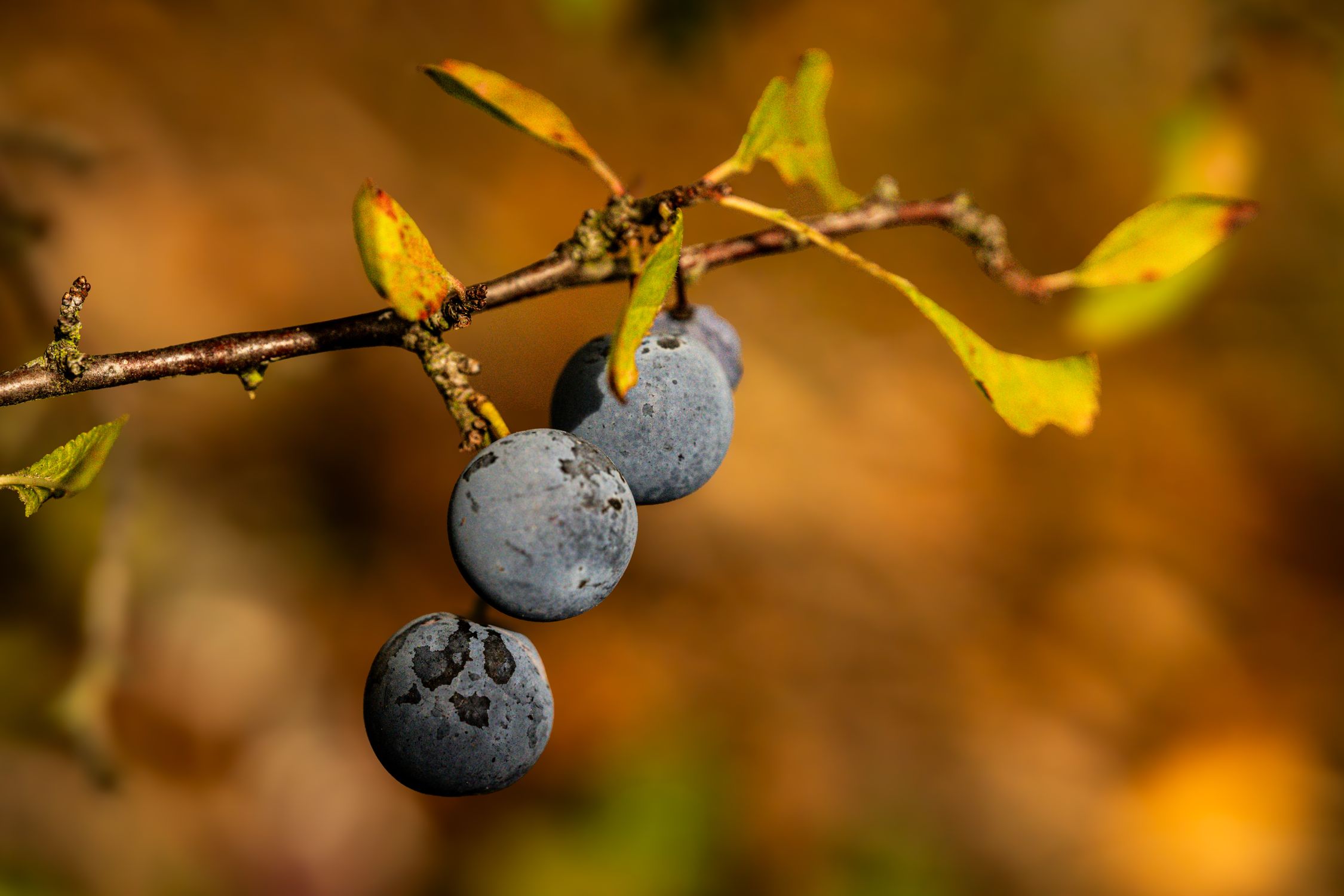
The berries (technically drupes, like cherries and plums, which are close relatives) are small — about 1 cm in diameter — round to slightly oval, with a dusty blue-black bloom over a deep purple skin. Inside, the flesh is greenish and the stone is distinctive, similar to a tiny plum stone. The colour is very dark and distinctive; there's nothing else in a British hedgerow that looks quite like a ripe sloe.
The most important potential confusion is with wild privet (Ligustrum vulgare), which has small black berries — but privet berries grow in loose upright clusters, the plant has no thorns, and the berries are much smaller and shinier. The other possible confusion is buckthorn (Rhamnus cathartica), which is also thorny and has small black berries — but buckthorn berries have four tiny petals at the tip when fresh, and the plant has a more open, less densely thorny habit. Neither is easily confused with sloes if you look closely.
When to Pick
The traditional rule is to wait until after the first frost, the idea being that frost breaks down the astringent tannins and improves the flavour. This is partly true — cold does soften the texture and mellow the bite slightly — but it's not necessary to wait for a hard frost if you're planning to steep the berries in alcohol or cook them. The gin or the heat does the same job.
A more practical guide: pick from mid-October to November, when the berries are fully ripe and dark all the way through. A ripe sloe should give slightly under gentle pressure and the flesh inside should be deep purple-red, not green. Underripe sloes are even more astringent than ripe ones, and the flavour doesn't develop properly.
If the autumn is mild and there's no frost forecast, you can simulate the frost effect by spreading the berries in a single layer on a tray and freezing them for 24 hours before using. Pricking each berry with a skewer or sharp knife before steeping achieves a similar result by breaking the skin and allowing the alcohol to penetrate faster.
Where to Find Sloes
Blackthorn is genuinely one of the most common shrubs in Britain, so you should be able to find it within reasonable distance of almost anywhere. It's a dominant plant in old mixed hedgerows — the kind with multiple species that follow old parish and field boundaries. These older hedges are particularly good for sloes because large established blackthorn thickets produce far heavier crops than young growth.
Look along footpaths, bridleways, and public rights of way through farmland. Country lanes with old hedgerows are often productive. Clifftops and coastal scrub, particularly in the south and west, can produce excellent crops because the salt wind limits competing growth. Woodland edges where open ground meets trees are another reliable habitat.
If you're foraging from hedgerows alongside arable fields, be aware that berries close to the road verge or field margin may have been sprayed with herbicide or pesticide. Pick from above knee height and away from the outer edge of the hedge where spray drift is most likely. Wash everything before processing regardless.
How to Forage Responsibly
The blackthorn thicket provides vital habitat for nesting birds — warblers, long-tailed tits, yellowhammers, and many others use dense thorny scrub for nest sites. Never forage during the nesting season (March to August) in a way that disturbs the habitat. In October and November this isn't a concern, but be aware of what the plant is doing ecologically beyond its crop.
Take no more than a third of the berries from any single plant, leaving plenty for birds (fieldfares and redwings arriving from Scandinavia in autumn rely heavily on hedgerow berries). Don't damage branches reaching for fruit — blackthorn thorns make it tempting to pull at branches, which can strip bark and harm the plant. A long-handled picking hook or a walking stick to draw branches towards you is much more effective and less damaging.
Always forage with landowner permission on private land. On public rights of way, picking reasonable quantities of wild fruit for personal use is generally accepted under common law, but commercial harvesting requires permission.
Processing and Recipes
Sloe gin (or vodka)
The classic. Fill a jar or bottle loosely with pricked sloes, add sugar (roughly 200 g per 500 ml of berries), pour over a full bottle of gin or vodka, seal, and shake. Store in a cool dark place and shake every few days for the first month, then leave for a minimum of three months — though longer (a year or more) improves it significantly. Strain off the liquid, bottle, and drink neat, with tonic, or as a cocktail ingredient. The strained berries, saturated with alcohol, can be used in chocolate truffles.
Sloe jelly
Cook the berries (no need to stone them) with water until soft, then strain through a jelly bag overnight — don't squeeze or the jelly will cloud. Measure the juice, add 500 g sugar per 500 ml juice, bring to a rolling boil, and set into sterilised jars. The result is deep, garnet-coloured, intensely fruity, and sets firmly because of the sloes' high pectin content. Excellent with game, cold pork, or strong cheese.
Sloe vinegar
An underrated product. Steep pricked sloes in cider vinegar for six weeks, strain, and bottle. The result is a richly flavoured fruit vinegar that works well in dressings, marinades, and pickling liquors.
Sloe berry cordial
Simmer the berries with water, strain, sweeten to taste, add a little lemon juice to balance, and reduce. Keeps refrigerated for several weeks and diluted with sparkling water makes a striking deep-purple drink. Use small quantities — the flavour is very intense.
Other Uses of Blackthorn
The wood of blackthorn is exceptionally hard and dense — it was traditionally used for walking sticks and the shillelagh of Irish tradition. The thorns are sharp enough that blackthorn has also been used as a natural barrier plant for centuries. Young blackthorn growth is also the host plant for several butterfly species including the Brown Hairstreak.
The blossom is one of the earliest nectar sources for bees emerging from winter — a fact worth bearing in mind before pruning or removing established blackthorn plants. The ecological value of a mature blackthorn hedge runs well beyond its sloe crop.
Frequently Asked Questions
Are sloes poisonous?
No. Sloes are edible but intensely astringent raw — the high tannin content makes them almost unpleasant to eat straight from the bush. They're not toxic in any way. The stone contains amygdalin (a cyanide precursor, as do all Prunus stones including plum, cherry, and apricot), but you'd need to crack and consume large numbers of stones to approach a harmful dose. Normal processing — jelly, gin, cordial — poses no risk.
Do I really need to wait for a frost?
No. The frost rule is a useful traditional guide for when the berries are ripe, but it's not strictly necessary. If frost hasn't come by mid-October and the berries are dark and slightly yielding, pick them and either freeze them yourself for 24 hours or just proceed with processing. Gin and heat do the job frost would otherwise do.
Why is my sloe gin still very bitter after three months?
More time is the answer. Three months is the minimum; six months produces a noticeably better result, and twelve months is better still. The astringency continues to mellow as the tannins bind with alcohol and sugar. If it's still bitter at three months, add a little more sugar, reseal, and leave it longer.
Can you grow sloes in a garden?
You can, but blackthorn is a vigorous suckering shrub that will spread steadily unless regularly managed. It's excellent as a wildlife hedge on larger plots and produces a good crop once established, but it's not a practical choice for small gardens. If you have the space and want a stock-proof wildlife hedge that also yields a harvestable fruit crop, it's an excellent plant.
What's the difference between sloes and damsons?
Both are Prunus species and both are small, astringent dark fruits — but they're distinct plants. Damsons (Prunus domestica subsp. insititia) are cultivated plums, larger than sloes (1.5–3 cm), oval rather than round, and typically found in old orchards and garden hedges. Sloes are smaller, rounder, and grow on the wild blackthorn in scrubby hedgerows. The flavour when cooked is similar but damsons are sweeter and more jam-suitable eaten as a fruit; sloes are principally a flavouring ingredient.
More Hedgerow Foraging Guides
Sloes are just the start of the autumn hedgerow. Wild damsons are the sloe's bigger, sweeter cousin and often grow in the same old hedge lines, elderberries ripen just ahead of sloe season, and if you're new to hedgerow picking, my UK wild berry identification guide covers every edible and poisonous species in one place.