| Botanical name | Crataegus monogyna |
|---|---|
| Family | Rosaceae |
| Hardy rating | RHS H7 (extremely hardy) |
| Fruiting season | September–November |
| Height (mature tree) | 5–15 m (clipped hedge: 1–3 m) |
| Position | Full sun to partial shade |
| Habitat | Hedgerows, woodland, scrub, roadsides |
| Edible raw? | Yes — mild, floury flavour |
Hawthorn is everywhere in Britain — one of the most common trees and hedgerow shrubs in the country, found from sea level to 600 m, from Cornwall to the Scottish Highlands. Most people know the blossom (may blossom, traditionally used for Mayday celebrations) and the thorns. Fewer people realise that the bright red berries, called haws, are edible and genuinely useful in the kitchen.
Haws won't win prizes for raw eating — they're mealy and mild, more like a tiny apple than a sharp wild berry — but they contain significant amounts of pectin, vitamin C, and antioxidant compounds, they're available in enormous quantities from late September through November, and they make excellent jelly, ketchup, fruit leather, and syrup. In a good hawthorn year, a single mature hedgerow tree can yield kilograms of berries that almost no one picks.
Identifying Hawthorn
Common hawthorn (Crataegus monogyna) is the species you'll almost always encounter in British hedgerows and woodland. There's also Midland hawthorn (Crataegus laevigata), which is similar but has slightly different leaf shape (less deeply lobed) and is more typical of ancient woodland understory — both species are edible and both produce haws that can be used interchangeably.
The leaves are deeply lobed into three to seven pointed segments — quite distinctive, like a small hand with stubby fingers. The blossom in May is white to pale pink, produced in dense clusters that have a strong, slightly musty scent (the compound responsible is trimethylamine, which is also present in human decay — which explains the long-standing folklore that it's unlucky to bring may blossom indoors). The thorns are stiff and sharp, 1–2 cm long, growing directly from the stems.
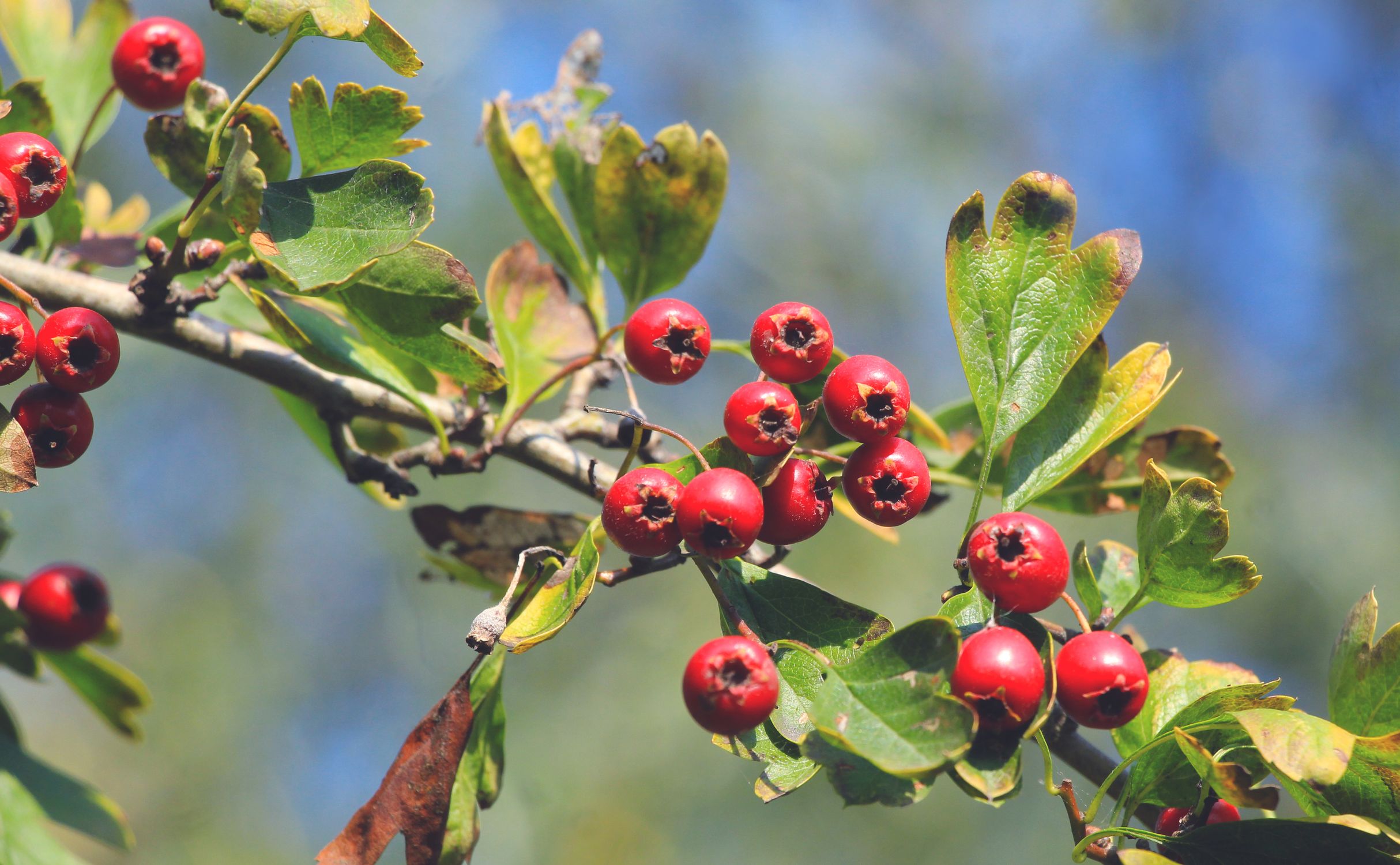
By September the tree is covered in bright red to deep crimson oval berries, each about 1 cm long, in dense clusters. Inside each berry there are usually one or two hard cream-coloured seeds (the "haw stone") surrounded by mealy, pale greenish-yellow flesh. The flesh is dry and floury rather than juicy — think of a very small crab apple.
The most likely confusion plant is rowan (Sorbus aucuparia), which also produces red berries in autumn. But rowan berries grow in flat-topped clusters and are distinctly round rather than oval; the rowan tree has pinnate leaves (like an ash tree — multiple paired leaflets on a central stalk), not lobed single leaves; and it has no thorns. The two are not easily confused once you've seen both.
When and Where to Pick
Haws ripen from late September through October and into November, with the peak window typically October in most of Britain. They'll stay on the tree for several weeks after ripening, so there's no need to rush — but hard frosts soften the berries and make them harder to process, so picking before the coldest weather is sensible.
Ripe haws should be a deep, glossy red and give slightly under gentle pressure. They don't continue to ripen off the tree, so don't pick too early. The colour deepens as they mature — pale orange-red haws are underripe; dark crimson ones are at their best.
Hawthorn is so widely distributed in Britain that finding it near you is rarely a challenge. Old hedgerows along footpaths and bridleways are the most productive locations; mature standard trees growing in hedgerows (allowed to grow upright rather than being laid or clipped) often carry the heaviest crops. Hawthorn also grows in open woodland, on moorland edges, and as scrub on chalk downland.
The same foraging principles apply as for other hedgerow fruits: take no more than a third of any individual plant's crop, leave plenty for birds (haws are a vital winter food source for fieldfares, redwings, blackbirds, and other thrushes), and avoid berries near heavily sprayed field margins. Wash everything thoroughly before processing.
Processing Hawthorn
Haws require some preparation because of the seeds. The most efficient approach is to simmer the berries briefly with water until soft (they'll break down quickly), then pass the pulp through a food mill or mouli to separate flesh from seeds and skins. The resulting purée or sieved juice is what most recipes use as the base. Don't attempt to stone them individually — it's impractical at any useful quantity.
The seeds should not be cracked or ground, as they contain amygdalin (as do apple seeds, cherry stones, and other Rosaceae seeds) — but this is only relevant if you were trying to process them into flour, which no one does. Normal cooking and straining poses no risk.
Recipes
Hawthorn jelly
The most popular use, and a straightforward one. Simmer haws with water until soft (about 30 minutes), strain overnight through a jelly bag — don't squeeze or the jelly will cloud. Measure the juice, add 500 g sugar and the juice of one lemon per 500 ml, bring to a rolling boil, and test for set. Pour into sterilised jars. The result is a dark amber jelly with a mild, fruity flavour that works with lamb, game, or strong cheese. You can add herbs — rosemary works particularly well — by steeping them in the hot jelly before jarring.
Hawthorn ketchup
An underrated product. Simmer haws to a pulp, pass through a mouli, then cook the purée with cider vinegar, sugar, spices (cloves, allspice, black pepper), and salt until thick. Bottle in sterilised jars. The result is a mild, mellow, slightly sweet condiment somewhere between tomato ketchup and brown sauce in character. It pairs well with game burgers, venison, or strong cheese.
Hawthorn fruit leather
Blitz the cooked and sieved haw purée with a little sugar and lemon juice until smooth, spread thinly on baking paper, and dry in the lowest setting of your oven (or a dehydrator) for several hours until leathery. Cut into strips and store in an airtight jar. Good as a long-lasting trail snack or a packed lunch treat.
Hawthorn berry tea
Dried haws (whole, dried at low temperature for several days until hard and leathery) brewed with hot water for five minutes make a mild, fruity tea that is high in antioxidants. This is the use most commonly cited in herbal traditions — hawthorn has a long history as a heart tonic plant, and modern research has found some evidence for its effectiveness in mild cardiovascular conditions, though this shouldn't be taken as medical advice.
Haw syrup
Simmer haws to a pulp, strain, sweeten the juice to make a syrup (roughly equal parts juice and sugar), and add lemon juice to preserve it. Keeps refrigerated for several weeks. Use as a cordial (diluted), a sauce for puddings, or a base for cocktails.
Wildlife Value
It's worth being conscious of how important haws are to wildlife before you pick heavily. Hawthorn is arguably one of the most ecologically valuable trees in the British countryside — the dense thorny habit is irreplaceable for nesting birds, and the berries are a critical autumn and winter food source for migrating and resident thrushes. Fieldfares and redwings arrive from Scandinavia in October and can strip a hawthorn tree within days.
The reasonable forager's approach: take from trees carrying very heavy crops, leave lighter-cropping trees entirely for wildlife, and pick before the migrating thrushes arrive in earnest (October in most years) if you want to guarantee a decent haul. A tree with a hundred kilograms of haws can spare a kilogram for you without ecological consequence.
Frequently Asked Questions
Are hawthorn berries safe to eat?
Yes, haws are safe to eat both raw and cooked. Raw they're mild and floury — edible but not exciting. Cooked and sweetened they're considerably better. The seeds contain amygdalin (a cyanide compound found in most Rosaceae seeds) but this is only a concern if you were cracking and eating large quantities of the seeds themselves, which no normal processing involves.
Can hawthorn berries be eaten raw?
Yes. They're not harmful raw and have a mild, slightly sweet, floury flavour — not unpleasant but not particularly exciting either. Children often eat a few from the hedge without any ill effect. The main limitation is that the flesh-to-seed ratio is low and the flesh is quite dry, so raw eating isn't very rewarding.
What do haws taste like?
Raw, mild and slightly floury — reminiscent of a dry, bland crab apple with very little juice. Cooked and sweetened, the flavour develops into something fruity and richly coloured, with a mild tartness. The flavour is subtle compared to blackberries or elderberries and benefits from pairing with sharper ingredients (lemon, vinegar) or strong flavours (game, cheese).
Do haws have any health benefits?
Hawthorn berries are rich in antioxidants, particularly oligomeric proanthocyanidins (OPCs) and quercetin. They also contain vitamin C. There's a significant body of research on hawthorn extracts in relation to cardiovascular health — mild blood pressure reduction and improved circulation have been reported in clinical studies. Most of this research uses concentrated standardised extracts rather than food quantities, so it's reasonable to view haws as a healthy food, but not as a medicine.
Is there a difference between may blossom and hawthorn blossom?
No — "may blossom" is simply the folk name for hawthorn blossom, because it typically flowers in May. The plant itself is hawthorn (Crataegus monogyna). The same plant produces both the spring blossom and the autumn haws.
More Hedgerow Foraging Guides
Hawthorn shares its hedgerows with most of Britain's other wild fruit: sloes ripen alongside haws in the same mixed hedges, elderberries come a few weeks earlier, and my wild berry identification guide is the place to start if you're still learning what's safe.