Walk along the sand dunes of the Norfolk, Lincolnshire or East Lothian coast in late summer and you'll spot dense thickets of silvery-leaved bushes studded with thousands of brilliant orange berries. That's sea buckthorn, and it's one of the UK's genuine hidden treasures: a native plant producing some of the most nutritionally dense berries on earth, yet still barely known to most British gardeners. I think that's a shame, because it's a remarkable thing to grow and forage, so let me share what I've learned about it.
| Common Names | Sea buckthorn, Sandthorn, Sallow thorn |
| Botanical Name | Hippophae rhamnoides |
| Family | Elaeagnaceae (olive family) |
| Native To | Native to the UK, coastal areas of eastern England and Scotland |
| Hardy in UK? | Fully hardy, RHS H7. Native and extremely tough |
| Taste | Intensely sharp, tangy and citrusy, like tart orange juice with tropical notes |
| Difficulty | Easy to grow, challenging to harvest (thorns!) |
| Time to First Fruit | 3 to 4 years from planting (both male and female plants needed) |
| Best For | Juice, oil, health supplements, hedging, coastal gardens, foraging, wildlife |
What Are Sea Buckthorn Berries?
Hippophae rhamnoides is a hardy, deciduous shrub native to the coasts of eastern England and Scotland, as well as great swathes of Europe and Asia. Its real party trick is thriving in the poorest, sandiest soils going, thanks to nitrogen-fixing bacteria in its roots, the same knack legumes have but a genuine rarity in a fruiting shrub. That's exactly what makes it so valuable for coastal stabilisation, wildlife habitat, and bringing degraded ground back to life.
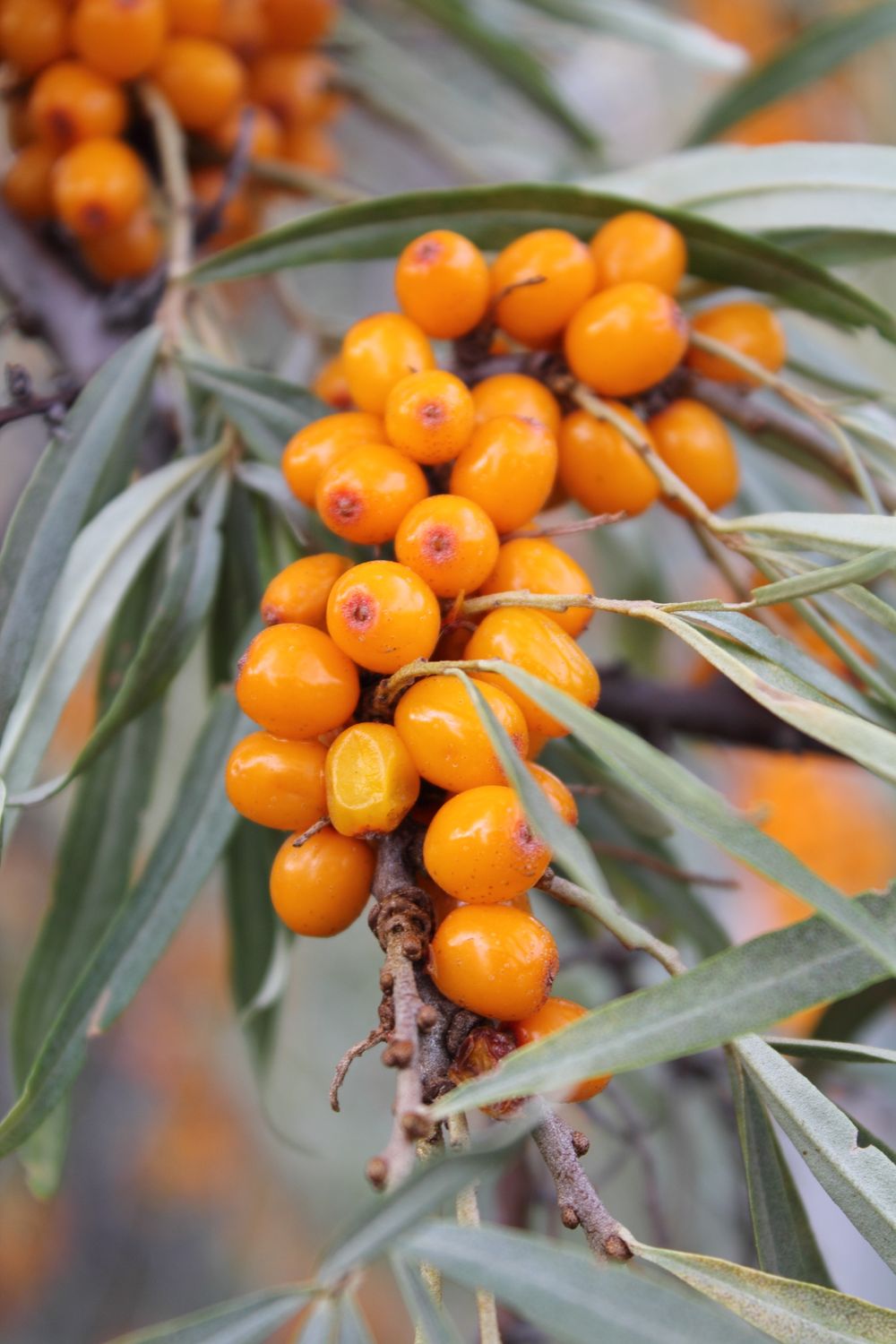
The berries are small, 6 to 9mm, spherical, and a vivid orange that lights up the whole coastline. The flavour is intensely tart and citrusy, far too sharp to eat raw by the handful, though I've met a few brave souls who manage it, yet absolutely magnificent juiced, turned into sauces, or pressed into oil. Sea buckthorn juice has become a sought-after health food in Scandinavia, Germany and, increasingly, here too, and it commands proper premium prices in the health food shops.
How to Grow Sea Buckthorn in the UK
Male and Female Plants
This is the part you cannot afford to get wrong. Sea buckthorn is dioecious, meaning each plant is either male or female. Only the females bear berries, but they need a male nearby to pollinate them, so you must plant at least one male for every six to eight females. They're wind-pollinated, so wherever you can, position the male upwind of the females.
The catch is that male and female plants are very hard to tell apart when young. Most reputable nurseries sell them clearly labelled, which is the easy route. Buy unnamed plants and you may be waiting 3 to 4 years until they flower before you know what you've got.
Site and Soil
Give it full sun and it will reward you. Sea buckthorn is wonderfully tolerant of poor, sandy and alkaline soils, and in fact it prefers a well-drained, fairly lean spot, since overly rich ground just pushes leggy growth with fewer berries. It's also extremely wind- and salt-tolerant, which makes it perfect for coastal and exposed gardens where little else will stand.
The one thing it genuinely dislikes is heavy, waterlogged clay, so avoid that. If your soil is on the heavy side, plant on a raised mound or work in plenty of grit to open up the drainage.
Planting
Plant bare-root or container-grown stock between November and March. Space them 1 to 1.5 metres apart for a hedge, or 2 to 3 metres apart for individual specimen bushes. Do bear in mind that it spreads by suckering, so unless you actively want a thicket, be ready to keep it in hand. Dig a generous hole, plant to the same depth as the nursery mark, and water it in well. In an exposed position it's worth staking for the first year.
Container Growing
You can grow sea buckthorn in large containers, though its natural vigour and suckering really make it happier in open ground. If you do go the pot route, use a very large container, at least 50 litres, filled with free-draining compost mixed with grit. You'll still need both a male and a female, which means at least two big pots. It's doable, but I wouldn't call it the easiest way to go about things.
Coastal and Exposed Gardens
For coastal planting, nothing really beats it. Its salt tolerance, wind resistance and ability to flourish in pure sand make it ideal where other fruit plants would simply give up, and it doubles as superb wildlife habitat and a valuable windbreak for sheltering more tender things tucked in behind it.
Best Varieties for UK Gardens
| Variety | Sex | Description | Where to Buy |
|---|---|---|---|
| Friesdorfer Orange | Self-fertile | A rare self-fertile variety that crops without a pollination partner. Compact (to 3m), thorny, with plentiful small to medium berries. The best choice for small gardens. | Specialist nurseries, online fruit suppliers |
| Askola | Female | Large, vigorous variety (4 to 5m) producing medium to large berries from late August. Excellent fruit quality. Needs a male pollinator. | Specialist nurseries |
| Leikora | Female | Heavy-cropping German variety with good-sized berries. Widely grown commercially in Europe. Reliable and productive. | Specialist nurseries |
| Hikul (Pollmix) | Male | Compact male pollinator, excellent for small gardens. Bears no fruit itself but is essential if you're growing non-self-fertile female varieties. | Specialist nurseries, Paramount Plants |
| Wild type H. rhamnoides | Mixed | The native species, sold as unnamed seedlings. Vigorous, thorny and variable. Buy in quantity for hedging or naturalising. | Hedging nurseries, wildlife garden suppliers |
Care and Maintenance
Pruning
Happily, sea buckthorn asks for very little pruning. In late winter, take out any dead, damaged or overcrowded branches, and that's largely it. The plant fruits on two- and three-year-old wood, so resist the urge to cut out productive branches. If it ever gets too big for its boots, you can cut it back hard and it'll regenerate vigorously from the base. One firm piece of advice: wear thick gloves and eye protection whenever you prune, because those thorns are vicious and the injuries are genuinely painful.
Managing Spread
It spreads by suckering, sometimes with real determination. To contain it, install a root barrier, buried polypropylene sheeting down to 60cm deep, or simply mow off any suckers that pop up beyond where you want them. Or, if you've the space, embrace the spreading habit and let it grow into a wildlife-rich thicket, which is no bad thing at all.
Feeding
Because it fixes its own nitrogen through those symbiotic root bacteria, sea buckthorn needs almost no supplementary feeding, and piling on nitrogen will actually reduce your fruit. A light application of potash in spring is about all it wants, and that can improve both the quality and the quantity of the crop.
Pests and Diseases
One of the joys of this plant is how remarkably pest- and disease-free it is in UK conditions. The few things to keep half an eye on are the sea buckthorn fly, a small fruit fly that lays its eggs in the berries, which isn't widespread here yet but is an emerging concern; there's no chemical control, so the answer is to remove and destroy any infested berries. Verticillium wilt occasionally strikes, causing wilting and dieback, so remove affected branches and don't plant where potatoes, tomatoes or strawberries have recently grown. And then there are the birds, with fieldfares and redwings feasting on the berries through winter, which is wonderful to watch but does dent your harvest. Net the bushes if you want to keep the crop, or plant generously and share with nature. All told, it's about as tough and resilient as anything you can put in a UK garden.
Harvesting, Storage, and Preserving
Harvesting is honestly the hardest part of the whole business. The berries ripen from late August into October but cling tight against the thorny stems, which makes hand-picking slow, messy and painful, and they burst at the slightest provocation, spilling their sticky orange juice everywhere.
There are some cleverer ways round it. The one I'd recommend for most home gardeners is freeze and shake: cut whole fruiting branches, freeze them for a few hours, then shake or tap the frozen berries off over a tray. Specialist berry-picking combs, or berry rakes, can also speed things along and are available from Scandinavian gardening suppliers. For small quantities, the scissors method works fine too, just snipping little clusters straight into a bowl, slow but effective.
Once you've got your harvest in, you've options. For juicing, blend the berries with a little water, strain through muslin and sweeten to taste, then dilute with sparkling water for something intensely nutritious and refreshing. To store, freeze them whole on trays, where they'll keep for up to a year and are actually easier to process from frozen. Both the flesh and the seeds hold valuable oils, though home oil extraction is complex, which is why commercial sea buckthorn oil fetches such premium prices. And for the kitchen, simmer the berries with sugar into a vivid orange sauce that pairs brilliantly with fish, duck and game.
Eating and Recipes
Let me be clear about the flavour: these berries are intensely tart, far too sharp for most of us to eat raw by the handful. The best way I can describe it is concentrated citrus, like very tart orange juice crossed with passionfruit and a hint of pineapple, and the aroma is properly tropical and unmistakable.
In the kitchen it's a wonderfully versatile thing. Sea buckthorn curd is a favourite of mine, made like lemon curd by cooking the strained juice with eggs, sugar and butter for something spectacular on toast or scones. The juice also whisks up with olive oil, honey and mustard into a stunning vinaigrette, and a tablespoon stirred into a fruit smoothie gives you a real vitamin C boost and a gorgeous colour into the bargain.
And the nutrition really is extraordinary. The berries pack 10 to 15 times more vitamin C than oranges, up to 800mg per 100g, alongside vitamins A, E, K and the B-complex. They're one of the very few plant sources of omega-7 fatty acid (palmitoleic acid), and carry omega-3, -6 and -9 too. Little wonder they've been used in traditional medicine across Asia and Scandinavia for centuries.
Foraging for Sea Buckthorn in the UK
Sea buckthorn grows wild along many stretches of our coastline, especially the east coast. The prime spots are the sand dunes of Norfolk and Lincolnshire, the Northumberland coast, and East Lothian up in Scotland, and it's also been planted in coastal nature reserves and along cliff-top paths.
Identification couldn't be much easier. You're looking for dense, thorny shrubs 2 to 5m tall, often forming impenetrable thickets, with distinctive narrow, silvery-green leaves rather like a willow, clusters of bright orange berries packed tightly along the stems from August through winter, and sharp thorns running throughout the branches.
Safety note: sea buckthorn has no dangerous lookalikes in the UK. That combination of silvery leaves, thorny stems and bright orange berries is unique and unmistakable. Even so, always be 100% certain of your identification before eating any wild berry.
Legal considerations: in England and Wales you have the right to forage wild fruit for personal use on public land under the Theft Act 1968 (Section 4). However, uprooting any wild plant is illegal without the landowner's permission. On nature reserves, check the local bylaws, as picking may be restricted. In Scotland, the right of responsible access under the Land Reform (Scotland) Act 2003 allows foraging for personal use.
Last thing, and I mean it: wear thick gloves and long sleeves when foraging, because the thorns are genuinely vicious, and take scissors to snip the clusters rather than tugging berries off one by one.
Frequently Asked Questions
Do you need a male and female sea buckthorn?
Yes, unless you go for a self-fertile variety like Friesdorfer Orange, you'll need at least one male for every six to eight female plants. Only the females bear berries, but they need wind-borne pollen from a nearby male to set fruit, and the male is best positioned upwind of the females.
Is sea buckthorn native to the UK?
Yes. Hippophae rhamnoides is native to the UK, found mainly on sand dunes and coastal cliffs along the eastern seaboard, and it's a valuable native species for coastal ecology and wildlife habitat.
How do you harvest sea buckthorn berries?
It's tricky, thanks to the sharp thorns and the berries' habit of bursting when picked. The most practical method for home gardeners is to cut the fruiting branches, freeze them for a few hours, then shake the frozen berries off over a tray, which spares you the painful job of hand-picking from thorny stems.
What are the health benefits of sea buckthorn?
The berries are exceptionally nutritious, with up to 800mg of vitamin C per 100g (10 to 15 times more than oranges), alongside vitamins A, E and K, omega-3, -6, -7 and -9 fatty acids, and powerful antioxidants. They've been used in traditional medicine for centuries.
Can you eat sea buckthorn berries raw?
Technically yes, but they're extremely tart and most people find them unpleasant raw in any quantity. They're far better juiced, cooked into sauces and syrups, or processed into oil. A few raw berries as a sharp, zingy snack are fine, just brace yourself for the intensity.
Where can you forage sea buckthorn in the UK?
Wild sea buckthorn is most abundant along the east coast of England and Scotland, especially on the sand dunes of Norfolk, Lincolnshire, Northumberland and East Lothian. It's also been planted in many coastal nature reserves and parks, and the bright orange berries stay visible from late summer right through winter.
Does sea buckthorn spread?
Yes, it spreads by suckering and will form dense thickets if left to its own devices. Install a root barrier or regularly remove the suckers to keep it contained in a garden, or alternatively lean into the spreading habit for wildlife hedging or coastal stabilisation.
Sea buckthorn is one of the toughest entries in my guide to unusual berries you can grow in the UK, and if its vitamin C credentials and coastal hardiness have caught your interest, that round-up covers the other superfruits and hedgerow oddities worth a spot in the garden.
If you're building a garden of tough, high-antioxidant superfruits, chokeberries (aronia) make a natural companion — and if you're weighing up which one to plant, my black vs red chokeberries comparison covers the differences.