Here's something I wish someone had told me when I started out: you don't need a garden to grow berries. A patio, a balcony, a doorstep, even a sunny windowsill will do the job. And honestly, with one or two fruits, pots beat open ground hands down, because you get to dictate exactly what the roots are sitting in rather than making do with whatever soil you inherited.
Why Containers Work for Berries
Berries take to pots for a handful of reasons that all stack up nicely. Most are compact, so they're not straining at the sides of a container. A lot of them are shallow-rooted and simply don't ask for deep soil. Some, blueberries being the obvious one, have fussy soil demands that are far easier to satisfy in a pot than across a whole bed. And they earn their keep visually too, sitting happily on a patio next to the ornamentals.
What I really value, though, is the way containers tidy up problems that would otherwise drive you mad. Chalky garden soil? Fill a pot with ericaceous compost and your acid-loving blueberries never know the difference. Slugs treating your strawberries as a nightly buffet? Lift them off the ground and the pests have a much harder climb. Renting, with no permission to dig? Pots come with you when you move. That last one matters more than people think.
The Best Berries for Pots
Strawberries
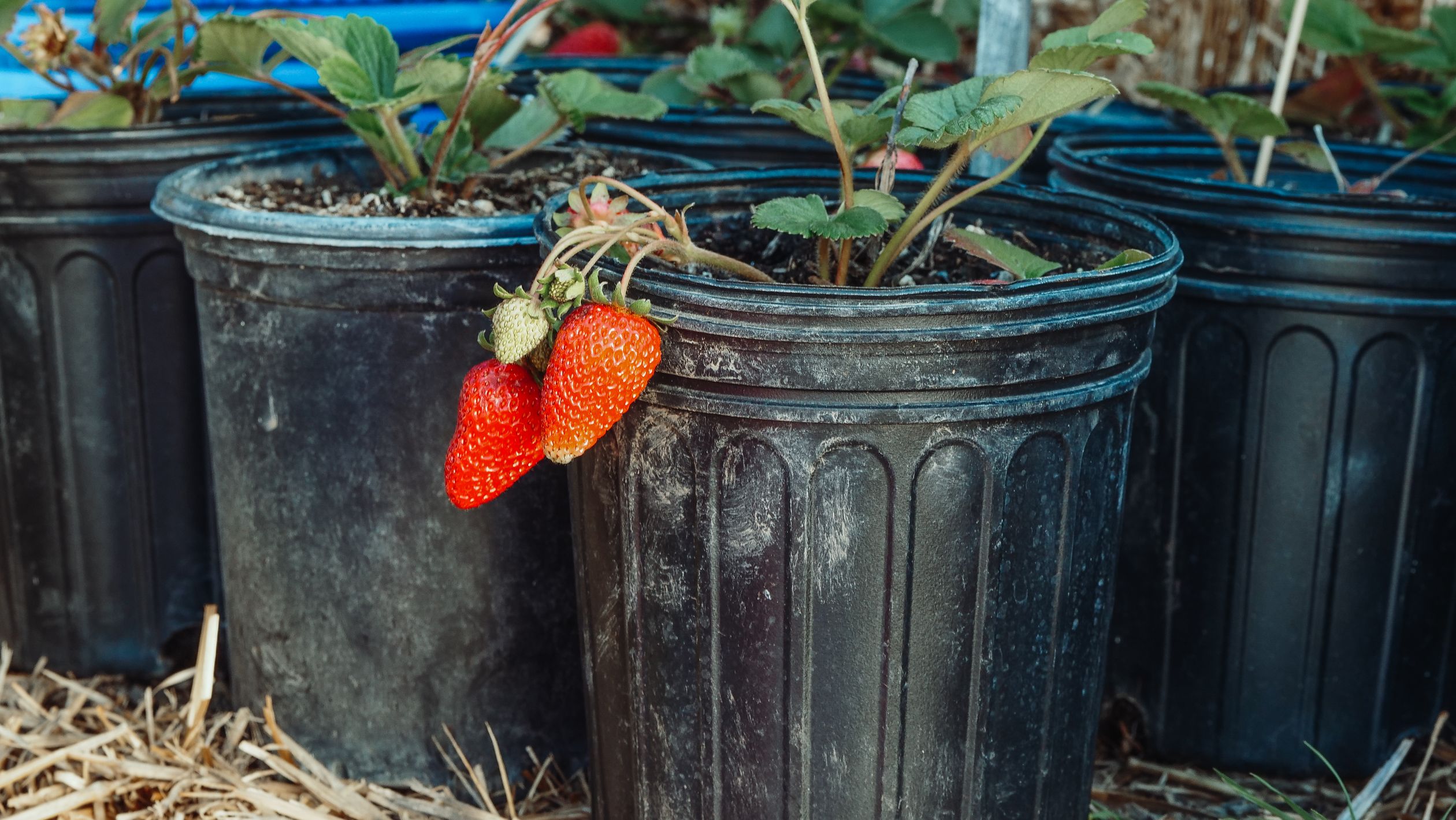
If I had to pick one container fruit above all others, it'd be the strawberry. Shallow roots, a compact habit, and the way they crop their hearts out make them ideal for pots, window boxes, hanging baskets and those vertical planters everyone's keen on these days. Pretty much anything at least 15 centimetres deep will keep them happy.
For pots I'd steer you towards everbearing varieties such as Albion, Mara des Bois, or Flamenco, which crop from June right through to October and reward you handsomely from just a few plants. Five or six will fit a 30 centimetre pot, or three in a hanging basket. Alpine strawberries are well worth a corner too, forming neat little clumps that throw out tiny, intensely flavoured fruit all summer and look lovely doing it.
Blueberries
For most of us in Britain, blueberries are genuinely better in a pot than in the ground. They insist on acidic soil, a pH between 4.5 and 5.5, and unless your garden happens to be naturally acidic, a pot of ericaceous compost is far less bother than trying to drag a whole border down the pH scale.
Go for a pot at least 40 centimetres across, fill it with peat-free ericaceous compost, and water with rainwater whenever you can, because tap water in hard-water areas slowly creeps the pH back up and undoes your work. Compact varieties like Top Hat, Sunshine Blue and Blueberry Burst are bred with containers in mind. One more thing, and it's important: plant at least two different varieties. Blueberries are technically self-fertile, but cross-pollination makes a real, visible difference to both the size and the number of berries.
Raspberries
Raspberries seem an odd choice for a pot until you try the compact varieties, which do surprisingly well in a large container, say 45 centimetres across and 40 centimetres deep. I'd always go autumn-fruiting here, because the pruning couldn't be simpler: cut every cane to the ground in February and let the plant get on with it, no fiddling about telling old wood from new.
Ruby Beauty is a dwarf variety bred for exactly this, topping out at just 60 to 90 centimetres. Autumn Bliss and Polka also perform well in pots if you give them a basic support of three canes and a bit of string.
Gooseberries
Gooseberries make excellent container plants, and they're at their best grown as standards, trained on a single clear stem about a metre tall with a bushy head on top. I love the look of them done this way: an ornamental lollipop that keeps the thorny branches up at a comfortable picking height and tucks neatly onto a patio. Use a pot at least 40 centimetres across, plant a reliable cropper like Invicta or Hinnonmaki Red, and feed with a high-potash fertiliser such as tomato feed from flowering onwards.
Blackcurrants, Redcurrants, and Whitecurrants
All three currants will grow happily in pots. The red and whitecurrants are the easiest of the lot, because you can train them as tidy cordons against a wall or fence and they ask for almost no room. A single cordon in a 30 centimetre pot can give you a kilogram or more of fruit, which still surprises me.
Blackcurrants are greedier. They want a bigger pot, at least 45 centimetres across, a compact variety such as Ben Sarek or Ben Gairn, and more food than their cousins, so a balanced fertiliser in spring and a mulch of compost over the surface will keep them content.
Cranberries
Cranberries are a quietly brilliant container plant: low-growing, evergreen, and dressed in red berries come autumn. Like blueberries they want acidic soil, so ericaceous compost in a pot suits them perfectly, and because they'll tolerate boggy ground they're forgiving if your watering hand is heavy. Give them a wide, shallow container, keep the compost consistently moist, and within a couple of years a single pot will fill out with their spreading, ground-cover stems.
Choosing the Right Container
When it comes to fruit, bigger is nearly always better. A larger pot holds more compost, stays moist for longer, and shields the roots from temperature swings, so my general rule is to use the biggest pot you can realistically manage.
Material matters less than size, though each has its quirks. Terracotta looks the part and is heavy enough to shrug off the wind, but it dries out fast and can crack in a hard frost. Plastic is cheap, light and good at holding moisture, yet it bakes quickly in direct sun. Fabric grow bags drain superbly and air-prune the roots, but they too dry out faster than a solid pot. Whatever you settle on, drainage holes are non-negotiable, because berries hate sitting in sodden compost, and if there's a saucer underneath, tip it out after heavy rain.
Compost and Feeding
For most berries I use a good peat-free multipurpose compost with around 20 percent perlite stirred through to sharpen up the drainage. Blueberries and cranberries are the exception, getting ericaceous compost and nothing else.
Pots need feeding more than you'd expect, because every watering washes nutrients out through the bottom. I give a balanced liquid feed every fortnight from spring to midsummer, then switch to a high-potash feed like tomato fertiliser from flowering onwards to push the plant towards fruit rather than leaf. Stop by late summer so everything can harden off before winter. Each spring, top-dress by scraping away the top few centimetres of tired compost and replacing it with fresh, and every three or four years repot into the same container with entirely new compost, trimming back any roots that have started circling.
Watering
If you take one thing from this article, make it this: watering is the single most important part of growing fruit in pots. Containers dry out far quicker than open ground, and on a hot summer's day a large pot in full sun can need watering twice.
Water thoroughly every time, until it runs from the drainage holes, because a quick splash only encourages surface roots that dry out faster still. A mulch of bark chips, gravel or straw over the compost cuts evaporation noticeably. And if all this sounds like a chore, self-watering pots with built-in reservoirs are a real help, especially when you fancy a weekend away in the middle of the fruiting season.
Winter Protection
Plants in pots feel the cold more keenly than those in the ground, simply because their roots are exposed to the air on every side rather than tucked into insulating soil. Across most of Britain that's no trouble at all for tough customers like gooseberries and blackcurrants, but blueberries and strawberries appreciate a little looking after.
A few simple moves go a long way: shift pots against a house wall, which gives off stored warmth; wrap them in bubble wrap or hessian to insulate the roots; and huddle them together so they shelter one another. In a really savage cold snap, move the tenderest plants into an unheated greenhouse, shed or garage. One thing worth remembering is that compost in a pot freezes solid more readily than garden soil. That rarely harms a dormant hardy plant, but it does mean it can't take up water, so on mild winter days check the compost isn't bone dry and give it a drink if it is.
This piece is about the mechanics of container growing — the pots, compost, watering and winter care that make any berry thrive away from open ground. If you're still weighing up which berries to actually grow in a small garden in the first place, my guide to the best berries for small gardens and containers is the better starting point, working through which fruit suits which space before you get to the practical setup.